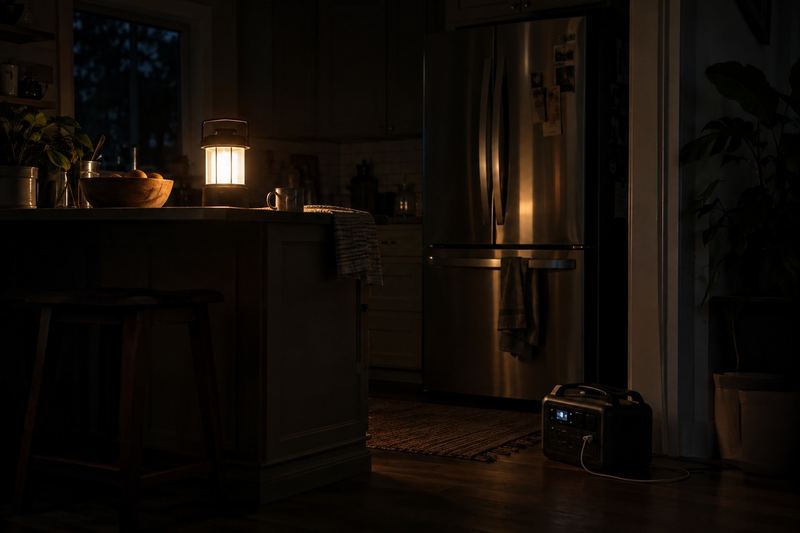
A CPAP uses much less power than its adapter rating suggests. ResMed's test data shows about 7 W for the machine alone, about 22 W with the heated humidifier, and about 34 W with a heated tube. A 300–500 Wh portable power station covers one to several nights, depending on whether the heaters are on.
Key facts
- ResMed measured an AirSense 10 at about 7 W without humidification, 22 W with the humidifier and 34 W with the humidifier plus a heated tube.
- Power supply ratings, such as the 65 W unit for the AirSense 11, are maximums, not typical draw.
- For one 8-hour night with the humidifier on, plan for about 210 Wh of power station capacity.
- Running from DC instead of the AC outlet avoids the inverter's conversion losses.
- Utility medical programs can give advance outage notices, but utilities say they can't guarantee your power stays on.
This guide covers electricity, not therapy. Ask your doctor or equipment supplier before changing how you use your machine, including turning off the humidifier.
How many watts does a CPAP use?
ResMed has published test measurements for its Air10 series. Under the test conditions (humidity setting 6, heated tube at 28°C, pressures of 8–15 cm H2O), they show:
| Setup | Average draw | Per 8-hour night |
|---|---|---|
| Machine only, humidifier off | About 7 W (plan on 10 W) | About 80 Wh |
| With heated humidifier | About 22 W | About 176 Wh |
| Humidifier plus heated tube | About 34 W | About 272 Wh |
| Bilevel or ASV, heaters on (upper end) | Up to about 44 W | About 352 Wh |
The humidifier and heated tube are the big variables: in ResMed's data they take the draw from about 7 W to about 34 W. Higher pressures and bilevel therapy add some too, as do a cold room and high humidity settings. Your machine may differ, so check its manual or ask the supplier. Our CPAP wattage page has the full data.
The power brick tells you little. ResMed's AirSense 11 power supply is rated 65 W, which is the most it can deliver, not what the machine normally uses. Sizing to the brick rating oversizes your battery a lot.
Should you run a CPAP from DC or AC?
A power station stores DC. Its AC outlet runs through an inverter that converts DC to 120 V AC, and the CPAP's own power supply then converts it back to DC. Each step wastes some energy. At very small loads, the inverter's own idle draw is a bigger share of the total.
Many CPAP makers sell a DC cable or DC converter for their machines, designed for a 12 V or 24 V source such as a power station's car-style outlet. Going DC to DC skips the inverter, so runtime is usually somewhat better than the AC math predicts. Use only the converter your maker specifies for your model, and ask your supplier if you're unsure.
If you use the AC outlet, choose a power station or generator with pure sine wave output, which matches the clean waveform of a wall outlet. Check your machine's manual for any guidance on power sources.
What size power station do you need for a CPAP?
We estimate runtime as capacity × 0.85 ÷ watts, so working backward, the capacity you need ≈ (watts × hours) ÷ 0.85. For 8-hour nights:
| Setup | 1 night | 2 nights | 3 nights |
|---|---|---|---|
| Humidifier off (10 W) | 95 Wh | 190 Wh | 280 Wh |
| Humidifier on (22 W) | 210 Wh | 415 Wh | 620 Wh |
| Humidifier + heated tube (34 W) | 320 Wh | 640 Wh | 960 Wh |
| Upper end (44 W) | 415 Wh | 830 Wh | 1,240 Wh |
These are estimates. Leave headroom: batteries lose capacity with age and in the cold, and they lose some charge in storage. In practice:
- About 300 Wh covers about one night with the humidifier on (not quite one with a heated tube too), or about three nights with the heaters off.
- About 500 Wh covers two nights with the humidifier on, or about five with it off.
- About 1,000 Wh covers about three nights even with the humidifier and heated tube on, with little to spare.
If the same station also has to run a router, phones or a refrigerator, add their usage. A fridge alone uses about 1.2–1.9 kWh a day. Our runtime calculator adds up mixed loads, and the power station runtime guide explains the math.
How can you stretch the battery?
- Ask your doctor or supplier whether you can turn off the humidifier and heated tube during an outage. If so, it is the biggest saving.
- Use the maker's DC cable or converter instead of the AC outlet when it's available for your machine.
- Keep the power station fully charged ahead of storm season and severe weather alerts.
- Recharge during the day from a car, solar panels or a generator running safely outdoors.
- Keep the station in a warm room. Cold cuts usable capacity.
Can you run a CPAP on a generator?
Yes. A CPAP's load is tiny for any generator, but power quality matters. An inverter generator gives cleaner output than many conventional open-frame models; see inverter vs conventional generators.
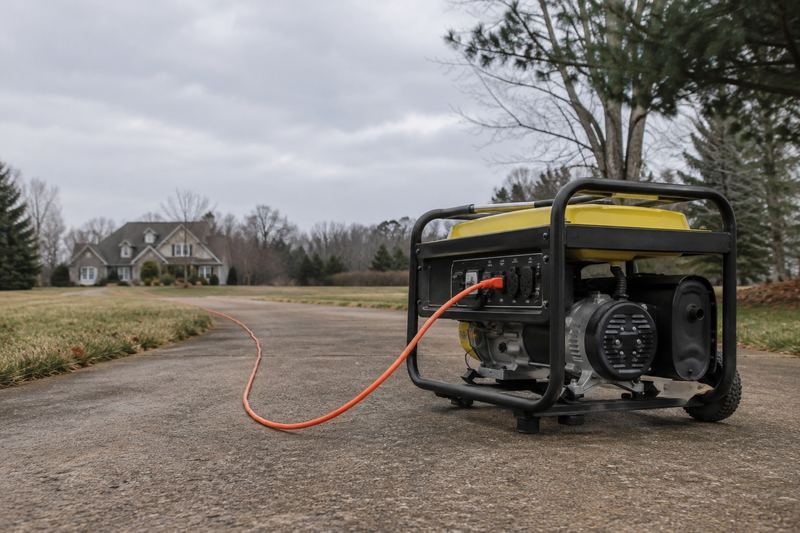
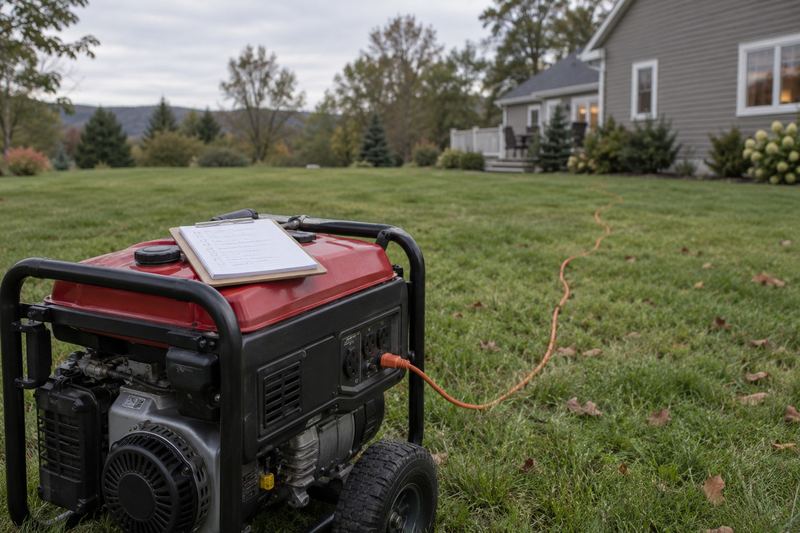
The bigger issue is overnight safety. CPSC says to run generators outdoors only, never in a home, garage or shed even with doors open, and at least 20 feet from doors, windows and vents. Keep battery-backup CO alarms in sleeping areas. A common approach is to recharge a power station from the generator during the day, then run the CPAP from the battery at night, with the generator off. Read our generator safety guide and power station vs generator comparison.
Does your utility have a medical program?
Many utilities run programs for customers who use powered medical equipment. Names and benefits vary: "medical baseline," "medical certificate" or a critical-care or life-support list. For example:
- SDG&E's Medical Baseline program lists CPAP machines among qualifying devices. It offers a billing discount and tries to notify enrolled customers before state-directed shutoffs. The utility says it can't guarantee power and advises customers to arrange backup power.
- Pacific Power's Medical Certificate program requires a form completed by a qualified medical professional. Its California Medical Baseline section notes that enrollment doesn't guarantee power won't be interrupted by weather.
Call your own utility and ask what it offers, how to enroll, and what notice it gives before planned shutoffs. Treat enrollment as a notification and billing benefit, not a backup plan. In a life-threatening emergency, call 911. If a household member also uses an oxygen concentrator, which draws far more power, work out that plan with the oxygen supplier. For the rest of your outage list, see what to run during a power outage.
Questions people ask
How long will a 500 Wh power station run a CPAP?
Roughly 19 hours (about two nights) at 22 W with the humidifier on, or about 40 hours (around five nights) at 10 W with it off. These are estimates; your machine and settings change the result.
Can I use my CPAP without the humidifier during an outage?
Many machines can run with the humidifier off, which cuts power use sharply, but whether that's OK for you is a question for your doctor or equipment supplier.
Do I need a pure sine wave power station for a CPAP?
For the AC outlet, pure sine wave is the safe choice for medical electronics. A maker-approved DC cable avoids the inverter altogether.
Will my utility restore my power first if I use a CPAP?
Don't count on it. Utilities with medical programs say they can't guarantee uninterrupted power, though some send advance notice of planned shutoffs. Ask yours what it offers.
Can I run my CPAP from a car?
Some machines can use a maker-approved 12 V DC cable or converter. Never run a vehicle in a closed garage, and check your machine's manual for supported power sources.