A portable power station is a battery with an inverter: silent, fume-free and safe to use indoors, but limited to the watt-hours stored inside it. A gas generator makes power for as long as it has fuel, so it handles bigger loads and longer outages, but it must run outdoors, away from the house.
Key facts
- A power station's capacity is fixed, in watt-hours (Wh). A generator's energy is limited only by how much fuel you have.
- CPSC says never to run a generator inside a home, garage, crawlspace or shed, even with doors or windows open. Keep it at least 20 feet from doors, windows and vents.
- A typical refrigerator uses about 1.2–1.9 kWh a day, more than most mid-size power stations hold.
- One manufacturer's guide rates LFP (lithium iron phosphate) power stations for roughly 3,000–4,000+ cycles to 80% capacity, against roughly 500–1,000 for NMC models.
- A "solar generator" is a power station sold with solar panels. It is not an engine.
What's the difference between a power station and a generator?
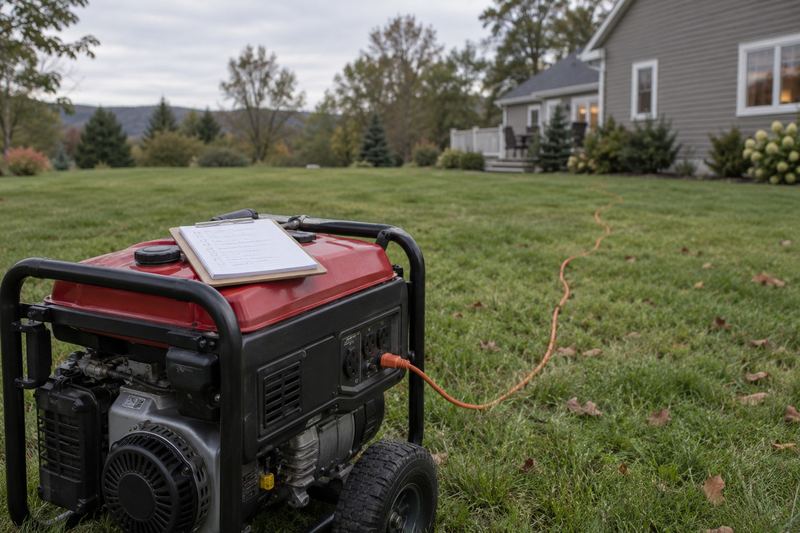
A portable generator burns gasoline, propane or both (see dual-fuel generators) to spin an alternator. As long as you keep adding fuel, it keeps producing power.
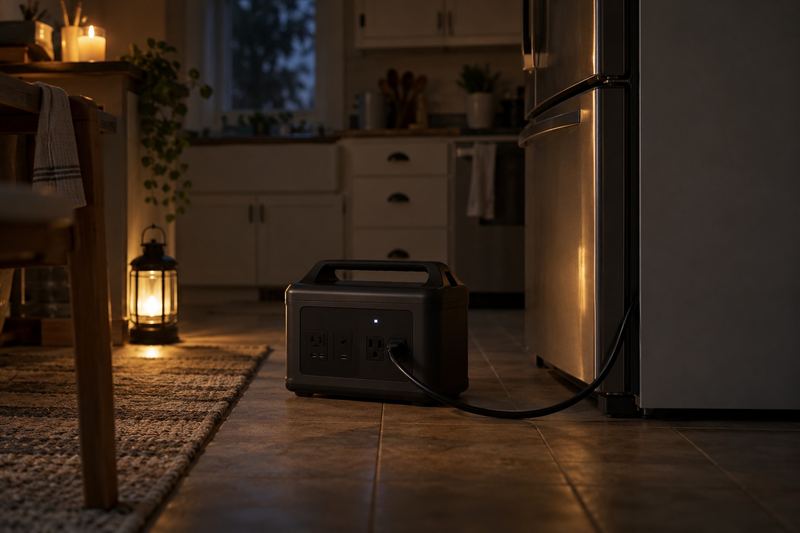
A portable power station stores electricity in a lithium battery and turns it into 120 V AC through a built-in inverter, with USB and 12 V DC ports as well. It makes no power of its own. You charge it ahead of time from a wall outlet, a car or solar panels, and then use up what it holds.
That one difference drives almost every trade-off below.
How do the two compare, spec by spec?
| Feature | Portable power station | Gas or propane generator |
|---|---|---|
| Energy supply | Fixed: the battery's Wh rating | As long as fuel lasts; refuel and keep going |
| Output (watts) | Set by the inverter's continuous rating | Set by the engine and alternator; larger models offer 240 V |
| Surge for motors | Inverter peak rating, often brief | Starting-watt rating |
| Indoor use | Yes; no exhaust | Never; outdoors only, 20+ ft from openings |
| Noise | Near silent; cooling fans under load | Engine noise; inverter generators are quieter than conventional |
| Recharge or refuel | Hours from AC; solar limited by panel watts and sun | Minutes to refuel (engine off and cool) |
| Maintenance | Little; keep it charged in storage | Oil changes, fuel treatment, regular test runs |
Capacity (Wh) vs fuel: which runs longer?
A power station's runtime is simple arithmetic: usable watt-hours divided by the load. Our working estimate is capacity × 0.85 ÷ average watts, which allows for inverter losses and the part of the battery the station holds back. A 1,000 Wh unit gives roughly 850 Wh to AC loads. The power station runtime guide works through the math.
Fridges are where the gap shows. ENERGY STAR listings put full-size refrigerators at about 1.2–1.9 kWh a day, so a 1,000 Wh station keeps one going for roughly 11–17 hours, not several days. A generator can run that fridge, a sump pump and a furnace blower for days, as long as you can buy and store fuel safely.
For small, steady loads the battery holds up well. A 15 W router and modem or a CPAP uses so little that a mid-size station lasts a long time.
Output watts and surge: can each start a fridge or pump?
Two numbers matter: continuous output (what it can supply all the time) and surge (what it can supply for a moment). Motors and compressors pull a short spike on startup. Generator makers' charts list about 2,200 W to start a refrigerator and about 2,150 W to start a 1/2 HP sump pump, against 150 W and 1,000 W running.
Generators state this as starting watts. A power station's inverter has its own peak rating, and a load that goes over it trips the station off. Check both figures against the single largest motor you'll start. The running vs starting watts guide explains how to add them up.
Voltage matters too. Most well pumps and electric water heaters run on 240 V. Many generators have a 240 V outlet, while most power stations offer only 120 V. Hardwired loads need a transfer switch or interlock installed by a licensed electrician either way. See transfer switches.
Can you use a power station or generator indoors?
A power station has no engine and no exhaust, so it can sit in a living room, bedroom or tent. Follow the maker's guidance on airflow and keep it dry. That alone is why many people buy one for apartments, medical devices and overnight use.
A generator can never run indoors. The Consumer Product Safety Commission says not to use one inside a home, garage, crawlspace, shed or similar space, even with fans running or doors and windows open. Keep it at least 20 feet from doors, windows and vents, and put battery-powered or battery-backup CO alarms in the house. Never plug a generator into a wall outlet to power the house ("backfeeding"). It endangers utility workers and neighbors. Our generator safety guide covers the rest.
Is a solar generator better than a gas generator?
A "solar generator" is a power station plus panels. Its strength is that it can recharge with no fuel. Its limit is how much the sun puts back in a day.
Rough solar input is panel watts × peak sun hours, where a peak sun hour is one hour of full-strength sunlight. For example, if your site gets 4 peak sun hours, a 200 W panel's best case is about 800 Wh. Real output is lower because of heat, panel angle, clouds, shade and charging losses. The station's maximum solar input rating also caps how much panel power it can use.
So a single 200 W panel can't keep pace with a fridge that uses 1.2–1.9 kWh a day. It can easily keep phones, lights, a router and a CPAP topped up. For heavy loads through a long outage, fuel still delivers far more energy per day.
Which costs more?
Prices move too fast to quote, but the pattern holds. For the same output in watts, a gas generator usually costs less up front. For the same amount of stored energy, batteries cost more: you pay for every watt-hour in the box.
Generators then cost money to run. You buy fuel, oil and stabilizer, and do the upkeep in our maintenance guide. A power station costs little to recharge from the wall and nothing from the sun, but its battery wears out with use.
How long does each last?
Battery life is counted in charge cycles. One manufacturer's guide gives roughly 3,000–4,000+ cycles to 80% capacity for LFP (LiFePO4) power stations and about 500–1,000 cycles for NMC lithium-ion models. Check the spec sheet for the chemistry, the cycle count and the capacity it's rated down to. A rating "to 70%" isn't the same as one "to 80%".
A generator's lifespan depends on engine hours and care: oil changes, fresh or stabilized fuel and regular exercise runs. Makers publish maintenance schedules rather than a single life figure, so we don't quote one here.
Which should you choose?
A power station fits best if you
- live in an apartment or have no safe outdoor spot 20+ feet from openings
- need quiet, indoor power for a CPAP, router, phones, laptop, lights or a fan
- face mostly short outages, or camp and want silent power
- can recharge from solar or a car during longer outages
A generator fits best if you
- need to run a fridge, freezer, sump pump and furnace blower together for days
- have 240 V loads such as a well pump (with a transfer switch installed by an electrician)
- can store fuel safely and run the unit outdoors, well away from the house
Many households use both: the generator runs outdoors during the day for big loads, and the power station covers quiet overnight needs indoors. To size either one, add up your loads with the generator size calculator or the runtime calculator.
Questions people ask
Can a power station replace a generator?
For small loads and short outages, often yes. For a fridge, freezer, sump pump and furnace over several days, a battery alone usually runs out unless you can recharge it a lot.
Can I run a generator in my garage with the door open?
No. CPSC warns against running a generator in a garage or any enclosed space, even with doors open. Keep it outside, at least 20 feet from doors, windows and vents.
Is a solar generator actually a generator?
No. It's a battery power station sold with solar panels. It stores energy and recharges from the sun, but it doesn't produce power on its own.
Can a power station run a refrigerator?
Usually, if its surge rating covers the compressor start. A 1,000 Wh station runs a typical fridge for roughly half a day to most of a day, depending on the fridge.
Is LFP better than NMC for a power station?
For lifespan, generally yes. One manufacturer's guide rates LFP for several times as many charge cycles as NMC. Compare the cycle count and the capacity it's rated to on each spec sheet.