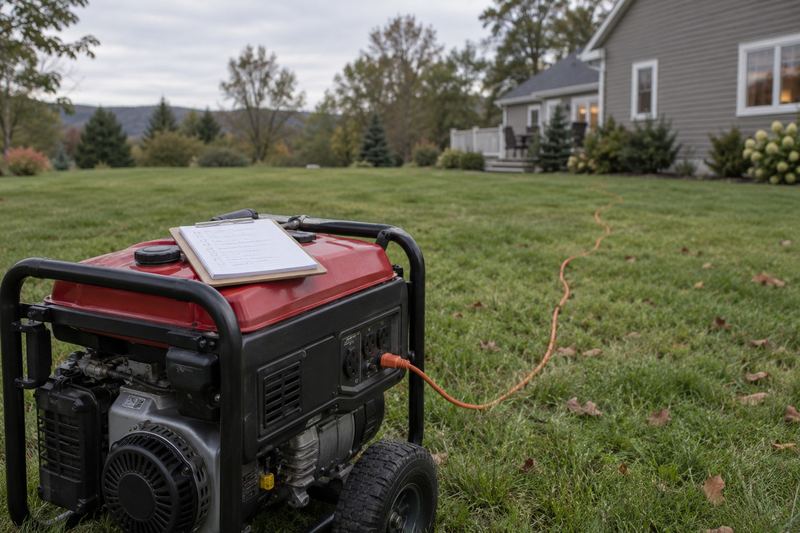
A generator transfer switch is a device, installed by a licensed electrician, that lets a generator power your home's circuits while keeping them disconnected from the utility lines. The National Electrical Code requires this kind of transfer equipment for standby connections. An interlock kit is a cheaper type of transfer equipment that mounts on your main panel.
Key facts
- NEC Article 702 (optional standby systems) applies to portable generators connected to home wiring, and it requires transfer equipment for that connection.
- Transfer equipment must prevent the generator and the utility from ever being connected to your house wiring at the same time.
- Plugging a generator into a wall outlet (backfeeding) can energize the power lines outside and electrocute utility workers.
- Portable generators usually connect through a listed power inlet box on the outside wall and a generator cord.
- Most areas require a permit and inspection, and installation is a job for a licensed electrician.
What does a generator transfer switch do?
Your home normally gets power from the utility. When you run a generator, the house has to switch over to the generator as its only power source. A transfer switch does that switching. It disconnects the circuits it serves from the utility before connecting them to the generator, so the two sources can never feed the same wiring at the same time.
That separation is the whole point. The electrical code describes transfer equipment as gear that prevents the "inadvertent interconnection" of the normal and alternate supplies. Without it, generator power can flow back out through your service and onto the neighborhood lines, and utility power can flow into a running generator when service returns.
Is a transfer switch required by code?
Yes, if the generator feeds your home's wiring. The National Electrical Code (NFPA 70) covers home backup generators in Article 702, "Optional Standby Systems." The article applies both to permanently installed standby generators and to portable generators connected to a building's wiring, and it requires transfer equipment for those connections. Section numbers have shifted between code editions, and each state or city adopts a particular edition with its own amendments, so your local building department has the final word.
Local rules usually spell this out. Placerville, California, for example, states that backfeeding outlets without a permanently installed transfer switch is not permitted, and it asks for a permit application, the switch's listing and installation instructions, and an electrical plan.
The code does not apply in the same way if you simply plug appliances into the generator's own outlets with extension cords. That setup never touches your house wiring. See generator safety for how to run cords safely.
Transfer switch vs interlock kit: what's the difference?
Both are forms of transfer equipment. They differ in how they are built and how much of the house they can reach.
Manual transfer switch
A manual transfer switch is a separate box mounted next to your main panel. An electrician moves a set number of circuits (often the ones you choose for an outage, such as the refrigerator, furnace blower, well pump and some lights) from the main panel into the switch. During an outage you flip each circuit, or the whole switch, from "line" to "generator." Some models are a small subpanel with its own breakers.
Interlock kit
An interlock kit is a mechanical plate or slide that mounts on the main panel's cover. It physically blocks the main breaker and a dedicated generator breaker from being on at the same time. With the main breaker off, the generator breaker can feed the panel, and you choose which branch breakers to turn on. Interlocks must be listed for your specific panel; a generic plate on the wrong panel may not pass inspection.
Automatic transfer switch
An automatic transfer switch (ATS) senses when utility power drops, starts a permanently installed standby generator, and transfers the load without you doing anything. It switches back when utility power returns and lets the generator cool down. These are paired with home standby units that run on natural gas or propane, not with portable generators.
| Option | How it switches | What it can power | Typical use |
|---|---|---|---|
| Manual transfer switch | You flip it by hand | A fixed set of selected circuits | Portable generator |
| Interlock kit | You turn off the main, then turn on the generator breaker | Any circuit in the panel, one at a time as load allows | Portable generator |
| Automatic transfer switch | Senses the outage and switches by itself | Selected circuits or the whole home, depending on design | Home standby generator |
The interlock's flexibility is also its main risk: nothing stops you from switching on more than the generator can handle. With either option you still have to keep the total load within the generator's running watts and leave room for the largest motor start. Our generator size calculator and the guide to running vs starting watts help you plan which circuits to use.
What is a generator inlet box?
A power inlet box is a weatherproof, recessed male connector mounted on an outside wall. The electrician wires it to the transfer switch or interlock. During an outage you set the generator outdoors, run a generator cord from its locking outlet to the inlet, start the generator and then transfer the load.
The inlet means you never run cords through a window or door, and it keeps the generator outside where its exhaust belongs. Inspectors generally expect the inlet to be listed for the purpose, and code calls for signs showing that a standby source is present. Placerville's checklist, for instance, asks for a listed inlet and a permanent sign identifying the type of generator connection.
Keep in mind that the inlet sets where the generator sits. The generator still has to be at least 20 feet from the house with its exhaust pointed away, according to the U.S. Consumer Product Safety Commission. Plan the inlet location and cord length with that distance in mind.
Why is backfeeding through an outlet dangerous?
"Backfeeding" usually means connecting a generator to a wall outlet or dryer receptacle with a cord that has a male plug on both ends, sometimes called a suicide cord. It is dangerous for several reasons:
- It can kill line workers. If your main breaker is on, the generator's output flows back through your meter to the utility transformer, which steps it up to distribution voltage. OSHA warns that a generator connected directly to a building can energize wiring far away and electrocute utility workers; the Electrical Safety Foundation (ESFI) gives the same warning.
- The exposed prongs are live. Once the generator runs, the free plug's metal prongs carry full voltage.
- It can overload wiring. A receptacle circuit is protected for its own wire size, not for feeding a whole panel. A typical 15 A outlet circuit is rated for 1,800 W (see watts, amps and volts).
- It can destroy the generator or start a fire. When utility power returns, the two sources collide.
- It breaks the code. The NEC requires transfer equipment, and local building departments do not allow outlet backfeeding.
There is no safe version of this. If you can't get a transfer switch or interlock installed before an outage, run appliances directly from the generator with outdoor-rated extension cords.
Do I need a permit and an electrician?
In most places, yes. Installing a transfer switch, interlock or inlet changes your home's electrical service, so it normally needs a permit and an inspection. A licensed electrician should do the work. They will choose equipment listed for your panel, size the conductors and breaker for your generator's output, handle grounding and neutral bonding correctly (this depends on how your generator is built), and add the required signs.
Plug Count does not give wiring instructions for this equipment. If your utility or insurer has requirements for standby generators, ask about them before the work starts.
How do I choose between them?
Start with what you want to run. List the essentials and their wattage on our appliance wattage pages, such as the refrigerator, furnace blower, well pump and sump pump. Then:
- A manual transfer switch suits people who want a simple, labeled set of outage circuits and less chance of overloading the generator.
- An interlock kit suits people who want access to any circuit and are comfortable managing the load by hand. It is usually the lower-cost option if a listed kit exists for your panel.
- An automatic transfer switch comes with a permanently installed standby generator for hands-off backup.
Also check whether the generator's outlets match. Many transfer switches and inlets expect a 240 V locking outlet, so a generator with only 120 V household outlets may limit your choices. A 240 V connection is needed for 240 V loads such as a well pump. For a broader look at backup options, see what size generator do I need.
Questions people ask
Is a generator interlock kit legal?
A listed interlock kit designed for your specific panel is a recognized form of transfer equipment and is accepted in many areas. Acceptance depends on your local code and inspector, so check with your building department and have a licensed electrician install it under a permit.
Can I just turn off the main breaker and backfeed through an outlet?
No. A main breaker alone is not transfer equipment, and nothing stops someone from switching it back on with the generator running. The double-plug cord is also live and dangerous to handle. The NEC and local rules require proper transfer equipment.
Do I need a transfer switch if I only use extension cords?
No. Plugging appliances straight into the generator's outlets with outdoor-rated cords doesn't connect to your house wiring, so no transfer switch is needed. The generator still has to stay outdoors, at least 20 feet from the house, per CPSC.
What is the difference between a manual and automatic transfer switch?
A manual switch is flipped by hand after you start a portable generator. An automatic switch senses the outage, starts a permanently installed standby generator, and switches the load over and back without anyone present.
Can I install a transfer switch myself?
This guide does not cover installation. The work modifies your electrical service, usually needs a permit and inspection, and should be done by a licensed electrician.
Sources
- NFPA: NFPA 70, National Electrical Code
- EC&M: Installation and operation of optional standby systems (NEC Article 702)
- Electrical Contractor: Generator connection, air conditioning protection and more
- City of Placerville: Residential portable generator transfer switch requirements
- OSHA: Using portable generators safely (fact sheet)
- Electrical Safety Foundation: Portable generator safety
- CPSC: Winter storm safety tips to prevent carbon monoxide poisoning and fires