The average US home uses about 865 kWh of electricity a month, according to the EIA's figures for 2024. That works out to roughly 10,400 kWh a year, or about 28 kWh a day. Your own use can be far higher or lower depending on climate, home size, and whether you heat, cool and cook with electricity.
Key facts
- EIA: the average US residential customer used 865 kWh a month in 2024, about 2% more than in 2023.
- That is about 10,400 kWh a year and roughly 28 kWh a day.
- Louisiana homes use the most electricity on average; Hawaii homes use the least.
- Air conditioning was the largest single household electricity use in EIA's 2020 survey, at 19%; space heating and water heating were 12% each.
- Keeping a fridge, lights, internet and a few small devices running takes only about 3 kWh a day.
How many kWh does the average house use per month?
The U.S. Energy Information Administration (EIA) reports that the average residential customer used 865 kWh per month in 2024, with an average monthly bill of $144. That is about 10,380 kWh for the year.
You will see other figures quoted, and they come from different EIA data sets:
- EIA's FAQ on home electricity use gives 10,791 kWh a year (about 899 kWh a month) for 2022, based on utility sales per residential customer.
- EIA's Residential Energy Consumption Survey (RECS) puts the average household at about 10,500 kWh a year for 2020.
All three land in the same range: roughly 10,000 to 11,000 kWh a year, or 850 to 900 kWh a month. Use 28 to 30 kWh a day as a ballpark national average.
How many kWh does a house use per day?
Divide the monthly figure by the days in the month. At 865 kWh a month, the average home uses about 28 kWh a day. Daily use swings widely through the year: a home with central air may use far more on a hot July day than in April, and an electrically heated home peaks in winter.
Why does electricity use vary so much by state?
Climate and heating fuel matter most. EIA's 2022 data shows Louisiana at the top with 14,774 kWh per residential customer for the year, and Hawaii at the bottom with 6,178 kWh. In EIA's 2024 figures, Louisiana households again used the most, more than twice as much as households in Hawaii or California.
Homes in hot, humid states run air conditioning for much of the year, and many Southern homes heat with electricity too. Homes in mild climates, or ones that heat with natural gas, oil or propane, use less.
What uses the most electricity in a house?
EIA's Residential Energy Consumption Survey breaks home electricity use down by end use. For 2020:
| End use | Share of household electricity (2020) |
|---|---|
| Air conditioning | 19% |
| Space heating | 12% |
| Water heating | 12% |
| Lighting and refrigerators | The next two largest uses, found in nearly every home |
The rest is spread across cooking, laundry, electronics, fans and many smaller loads. Here is how some common appliances compare on a typical day:
| Appliance | Running watts (typical) | Typical kWh per day |
|---|---|---|
| Central air conditioner (~3 ton) | 3,500 W | About 29 (hot day) |
| Electric water heater | 4,500 W | About 13.5 |
| Space heater (8 h, cycling) | 1,500 W | About 6 |
| Electric dryer | 5,000 W | About 2.6 |
| Refrigerator | 150 W | About 1.45 |
| TV (5 h) | 80 W | About 0.4 |
| Wi-Fi router | 15 W | About 0.36 |
The pattern is clear: anything that makes heat or cold (air conditioning, heating, water heating, drying clothes) dominates. Electronics and lighting are small by comparison. For a longer list, see the appliance wattage list.
How do I find out how many kWh my house uses?
Your electric bill is the best source. Look for:
- Usage or "kWh used" for the billing period. This is usually shown as the difference between the current and previous meter readings, or as a single figure from a smart meter.
- Days in the billing period. Divide total kWh by days to get your daily average.
- A 12- or 13-month usage chart. Most bills show one. It reveals your summer and winter peaks, which is where your average hides the most.
- Average daily use. Many utilities print this directly, sometimes next to the same month last year.
If you have a smart meter, your utility's website or app may show use by day or by hour. Hourly data shows your overnight "base load," which is a useful starting point for backup planning.
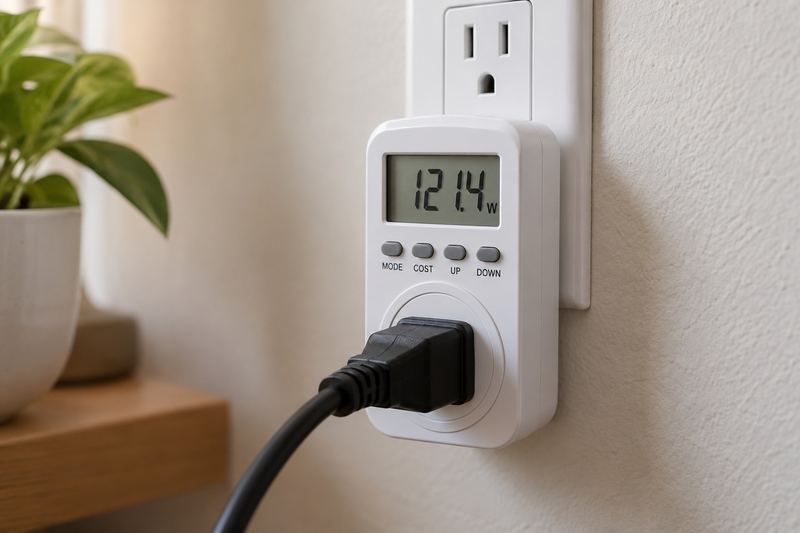
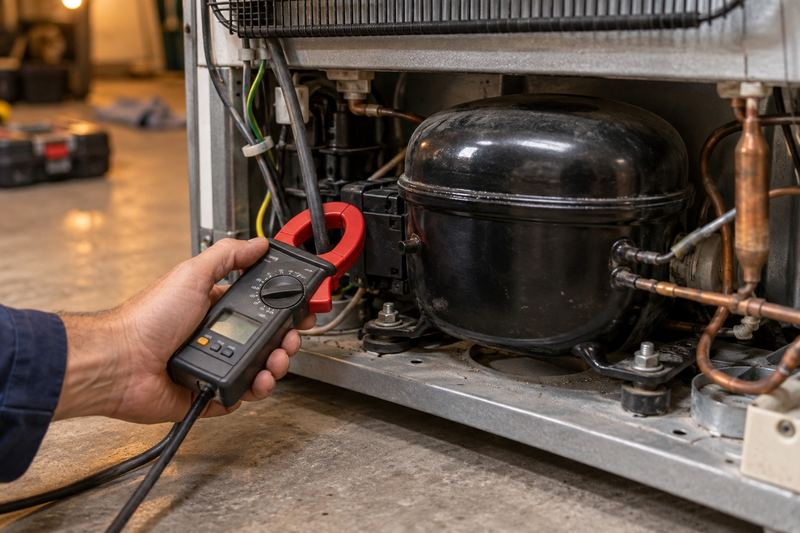
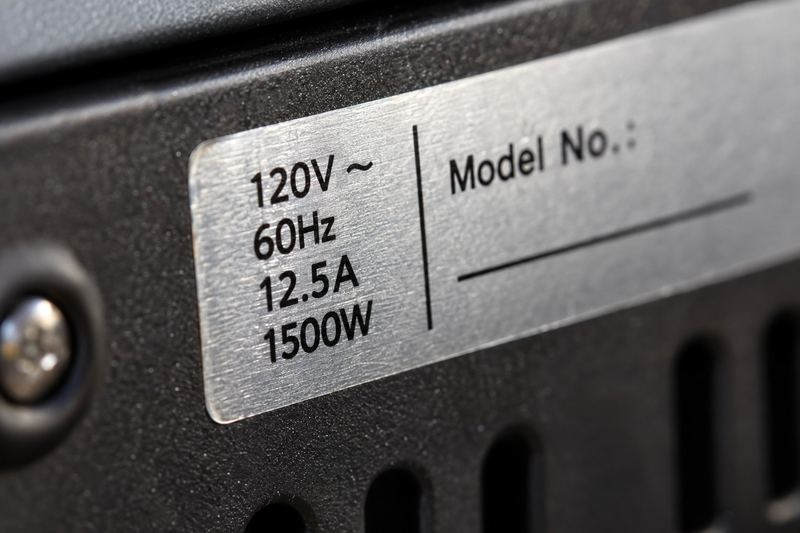
To work out what a single appliance uses, multiply its watts by the hours it runs and divide by 1,000 (kWh = watts × hours ÷ 1,000). Our guide to measuring appliance watts explains how to find the watts, and the watts, amps and kWh converter does the math.
Do I need to back up all 28 kWh a day in an outage?
No. Your daily total includes loads you can switch off or delay during an outage: central air, electric water heating, laundry and cooking. Backup power is about keeping the essentials running, and the essentials use far less.
| Essential load | Typical kWh per day |
|---|---|
| Refrigerator | 1.45 |
| Chest freezer | 0.6 |
| Wi-Fi router | 0.36 |
| TV (5 hours) | 0.4 |
| 5 LED bulbs (3 h each) | About 0.14 |
| CPAP (8 h, with humidifier) | 0.18 |
| Two phone chargers | 0.06 |
| Total | About 3.2 |
That is roughly a ninth of an average home's daily use. A sump pump in a storm, a well pump or a furnace blower in winter adds more, so include them if your home depends on them.
Energy (kWh) and power (watts) are separate questions
Daily kWh tells you how much stored energy you need: how big a battery or power station, or how much fuel. The highest wattage running at once, plus the largest motor's starting surge, tells you how big a generator or inverter you need. A fridge uses only about 1.45 kWh a day, but it can briefly need about 2,200 W to start its compressor. Running vs starting watts explains why.
For a battery, a rough runtime estimate is capacity (Wh) × 0.85 ÷ average watts. The essentials above average about 135 W across a day (3,200 Wh ÷ 24 h), so a 2,000 Wh power station would last roughly 2,000 × 0.85 ÷ 135 ≈ 12–13 hours. That is an estimate; inverter losses and battery depth vary by model. Try your own numbers in the runtime calculator, or size a generator with the generator size calculator. For which loads to prioritize, see what to run during a power outage.
Questions people ask
How many kWh does a house use per month?
The EIA reports an average of 865 kWh per month per residential customer in 2024. Homes in hot Southern states often use much more; homes in mild climates or with gas heat use less.
How many kWh does a house use per day?
About 28 kWh a day on average (865 kWh ÷ about 30.4 days). Your bill's average daily use will show your own figure.
Is 1,000 kWh a month a lot?
It is somewhat above the 2024 US average of 865 kWh, but normal for a larger home, a hot climate, or a home with electric heat or an electric water heater.
How many kWh does a house use per year?
Roughly 10,000 to 11,000 kWh. EIA figures range from about 10,400 kWh (2024) to 10,791 kWh (2022), depending on the year and data set.
Can a portable power station run my whole house?
Not for long. An average home uses about 28 kWh a day and draws large loads like central air; portable power stations are sized to keep essentials such as a fridge, lights, internet and medical devices running.
Sources
- U.S. Energy Information Administration: Residential electric bills in Hawaii and Connecticut are twice those in New Mexico, Utah (2025)
- U.S. Energy Information Administration: How much electricity does an American home use?
- U.S. Energy Information Administration: Electricity use in homes
- U.S. Energy Information Administration: Measuring electricity
- U.S. Department of Energy: Estimating appliance and home electronic energy use