To find an appliance's wattage, check its rating label (nameplate), usually on the back, bottom or inside the door. If it lists watts, you're done; if it lists volts and amps, multiply them (120 V × 10 A = 1,200 W). That figure is a maximum. To see what the appliance really draws, plug it into a watt meter.
Key facts
- The nameplate is usually stamped or stuck on the back or bottom of the appliance, or on its power supply.
- Watts = volts × amps. A label reading 120 V, 5 A means up to 600 W.
- Nameplate watts are a maximum; most appliances draw less most of the time.
- A plug-in watt meter shows real watts and totals kWh over hours or days.
- EnergyGuide labels list estimated yearly kWh for many appliances; multiply by 1,000 and divide by 8,760 hours to get average watts.
Where do I find the wattage on an appliance?
Look for the rating label, also called the nameplate or data plate. The U.S. Department of Energy notes that wattage is usually stamped on the bottom or back of an appliance, or on its nameplate. Common places to check:
- Small kitchen appliances (toasters, kettles, coffee makers, air fryers): the underside.
- Refrigerators and freezers: inside the fresh-food compartment on a side wall, or behind the kick plate at the bottom front.
- Microwaves: the back panel or inside the door frame.
- Washers and dryers: inside the lid or door, or on the back.
- Window and portable air conditioners: the side of the cabinet, sometimes behind the front grille.
- Electronics (laptops, routers, TVs): the external power adapter or "brick," or a label on the back of the device.
- Tools and pumps: a plate on the motor housing.
If the label is worn off, the owner's manual and the manufacturer's spec sheet list the same ratings. Search the model number, which is printed on the same label.
How do I read the nameplate?
A rating label lists some combination of:
- Watts (W) or kilowatts (kW): the power rating. Use it directly.
- Volts (V): usually 120 V (often written 115 V or 120 VAC) for plug-in appliances, or 240 V (sometimes 230 V) for dryers, ranges and water heaters.
- Amps (A): the current the appliance is rated to draw.
- Hz: 60 Hz in the US. It doesn't affect the wattage math.
Only amps are listed? Multiply by volts
If the label gives volts and amps but no watts, multiply them. A dehumidifier labeled 115 V, 4 A is rated about 460 W. A label with 240 V and 18.8 A means about 4,500 W. Our watts to amps converter does this for you, and watts, amps and volts explained covers the formulas.
For motors and compressors, volts × amps slightly overstates the real watts (the difference is called power factor). That errs on the safe side for planning a circuit or generator.
Microwaves list two numbers
Microwaves are usually advertised by cooking power, but the label also shows input power, which is what your outlet or generator must supply. Panasonic, for example, lists a 1,200 W model at 1,480 W input. Always use the input figure. See how many watts a microwave uses.
Why is the nameplate wattage higher than what the appliance actually uses?
The rating is the most the appliance is designed to draw, not what it uses minute to minute. Several things push real use lower:
- Thermostats cycle. A refrigerator compressor runs only part of the time; DOE suggests estimating fridge run time as about a third of the hours it is plugged in.
- Settings vary. A space heater pulls 1,500 W on high but about 750–900 W on low.
- Labels include extras. A fridge's rating covers the defrost heater and ice maker, which don't run constantly.
- Power supplies are sized for the worst case. A laptop charger rated 65 W often supplies much less once the battery is full.
The nameplate also doesn't show starting surge. Motors and compressors draw a short burst of extra power when they start, often several times the running watts. A fridge that runs at about 150 W may need around 2,200 W for under a second at start-up. If you are sizing a generator, read running vs starting watts.
So use the nameplate as a safe upper limit for circuit and generator planning, and measure when you need real-world energy use for battery runtime or your bill.
How do I measure an appliance's actual watts?
Use a plug-in watt meter
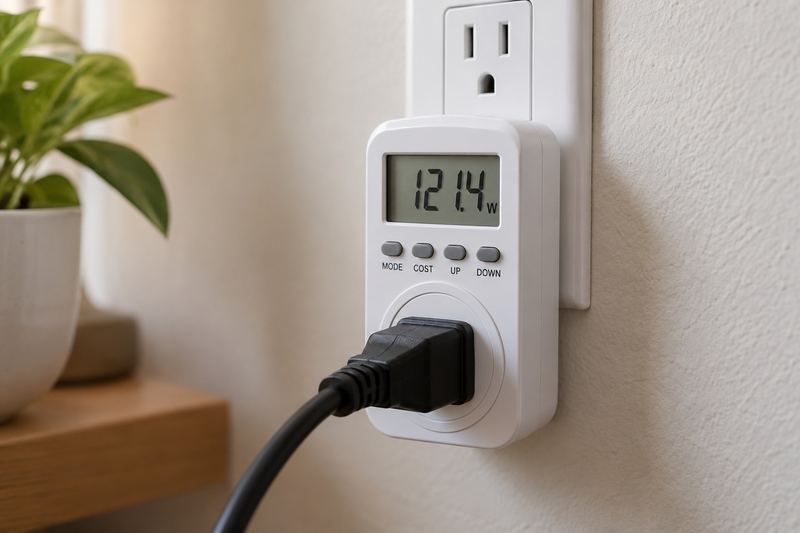
A plug-in electricity usage monitor (often just called a watt meter) is the easiest and safest way for a homeowner to measure. You plug the meter into the wall, plug the appliance into the meter, and read the display.
- Plug the meter directly into a wall outlet, not a power strip.
- Plug in the appliance and turn it on.
- Read watts for the draw right now. Try each setting or cycle (heat vs. fan, wash vs. spin).
- Leave it connected for 24 hours, or a full week for things that cycle, and read the kWh total. Divide by the hours to get average watts.
Measuring over time matters for cycling appliances. A fridge might show 150 W while the compressor runs and only a few watts between cycles, but the kWh total tells you what it really uses in a day. Most of these meters fit a standard 120 V, 15 A outlet, so they can't measure 240 V appliances or hard-wired equipment. The quick reading may also miss the split-second starting surge.
Clamp meters are for electricians
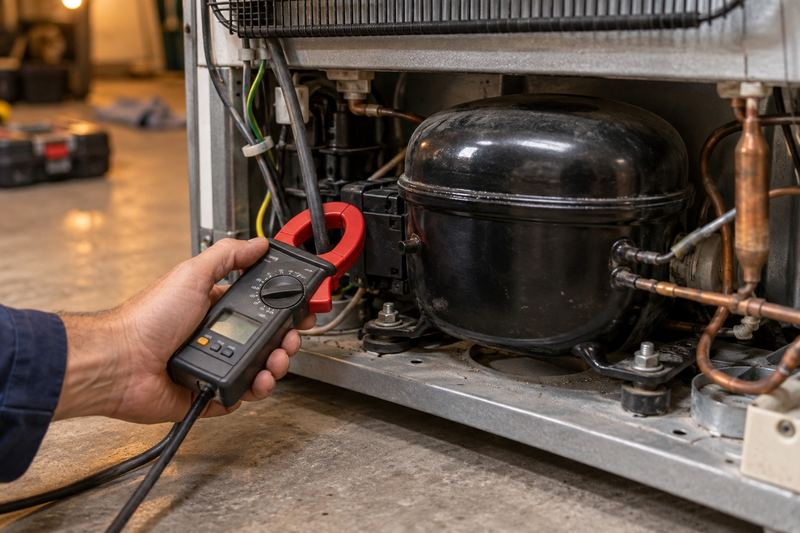
A clamp meter (clamp-on ammeter) measures current by closing its jaws around a single wire. It works on hard-wired and 240 V loads such as well pumps, water heaters and central air, but it has to clamp one conductor, not a whole cord, so it usually means opening a panel or junction box. Leave that to a licensed electrician. Multiply the reading by the voltage to estimate watts.
Check your smart meter or panel monitor
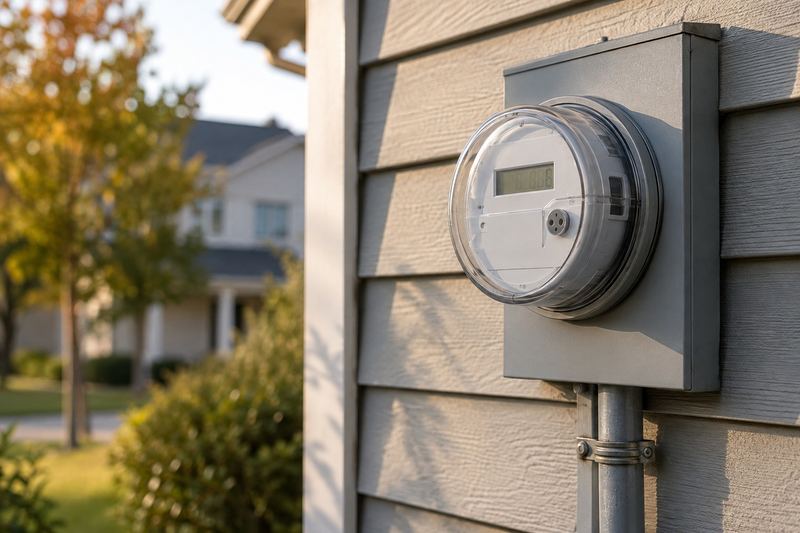
If your utility offers hourly data from a smart meter, switching a large appliance on and off and watching the change can give a rough figure. Whole-home energy monitors installed in the panel by an electrician do the same in more detail.
How do I use EnergyGuide and ENERGY STAR labels?
The yellow FTC EnergyGuide label comes on refrigerators, freezers, dishwashers, clothes washers, water heaters, room and portable air conditioners, TVs and other products. It shows an estimated yearly operating cost and, for many products such as refrigerators, freezers and TVs, an estimated yearly electricity use in kWh. ENERGY STAR's product finder lists the same annual kWh for certified models.
To turn yearly kWh into average watts:
Average watts = kWh per year × 1,000 ÷ 8,760 (hours in a year)
| Label figure | Calculation | Average draw |
|---|---|---|
| 25 cu ft top-freezer fridge, 425 kWh/yr | 425,000 ÷ 8,760 | About 49 W |
| 25 cu ft bottom-freezer fridge, 615 kWh/yr | 615,000 ÷ 8,760 | About 70 W |
| 55-inch TV, 120 kWh/yr (5 h/day basis) | 120,000 ÷ (365 × 5) | About 66 W while on |
For a fridge or freezer, which runs around the clock, divide by 8,760. For a TV, the label assumes five hours of viewing a day, so divide by 1,825 hours to get watts while it's on. Label estimates use standard test conditions; a hot kitchen, frequent door openings or bright picture settings push real use higher.
What should I do with the numbers?
- For a generator: add up running watts of everything you'll run at once, then add the largest starting surge. The generator size calculator does this.
- For a power station: use measured average watts. Runtime ≈ capacity (Wh) × 0.85 ÷ average watts, an estimate since inverter losses and battery depth vary. Try the runtime calculator.
- For your bill: kWh = watts × hours ÷ 1,000. Compare with how many kWh a house uses.
No label or meter handy? The appliance wattage list gives typical running and starting watts for common household items.
Questions people ask
How do I find the wattage if the label only shows amps?
Multiply amps by volts. At 120 V, an appliance rated 8 A is about 960 W; at 240 V, 20 A is 4,800 W.
Is the wattage on the label what the appliance always uses?
No. It is the maximum rated draw. Thermostats, settings and cycling mean most appliances use less on average, which a watt meter will show.
Can a plug-in watt meter measure a dryer or water heater?
No. Plug-in meters fit standard 120 V outlets. Large 240 V and hard-wired appliances need a clamp meter reading by an electrician, or use the nameplate rating.
How accurate are EnergyGuide kWh figures?
They come from standardized federal test procedures, so they are good for comparing models. Your real use depends on room temperature, settings and how often you use the appliance.
Does the label show starting watts?
Usually not. Motors and compressors briefly draw several times their running watts at start-up; generator makers' wattage charts list typical starting figures.
Sources
- U.S. Department of Energy: Estimating appliance and home electronic energy use
- Virginia Cooperative Extension: Estimating appliance and home electronic energy use
- FTC Consumer Advice: How to use the EnergyGuide label to shop for home appliances
- ENERGY STAR: Certified 25.0 cu ft top-freezer refrigerator (425 kWh/yr)
- ENERGY STAR: Certified 25.2 cu ft bottom-freezer refrigerator (615 kWh/yr)
- Panasonic: NN-SN67KS microwave features and specifications